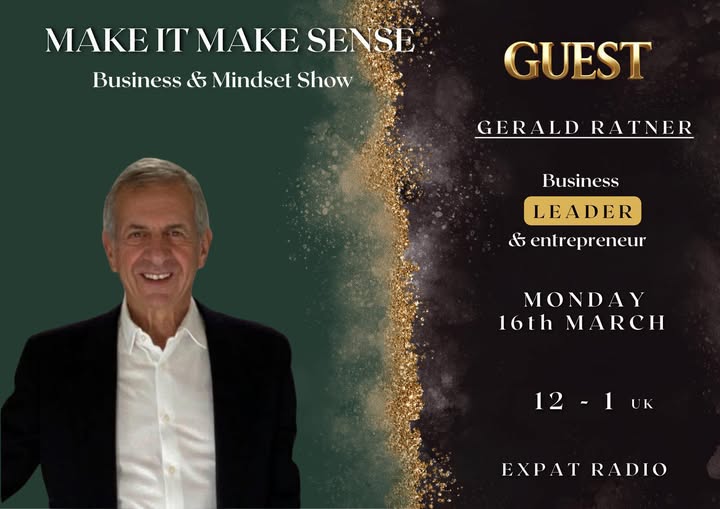
There are few business stories as dramatic—and as instructive—as that of Gerald Ratner. This week on the Lunchtime Show, we had the privilege of sitting down with the man himself, alongside our wonderful hosts Claire Stanley and Neville Wright, for a conversation that spanned the highest of highs, the lowest of lows, and a remarkable comeback that continues to unfold.
The Rise
Gerald Ratner was born on 1 November 1949 in London to a Jewish family. He joined the family Jewellery business in 1966 and, during the 1980s, built it into an extraordinarily successful chain. The Ratners Group—which included Ratners, H. Samuel, Ernest Jones, Leslie Davis, Watches of Switzerland, and over 1,000 shops in the United States including Kay Jewelers became the world’s largest jewellery retailer. At its peak, the company had 2,500 shops, was making £125 million in profit, and had a turnover of £2 billion
How did he do it? By disrupting a staid industry. “Before we did any of those promotions, we were struggling in the early ’80s,” Ratner explained on the show. He discovered a jeweller in Newcastle who was playing pop music, running constant sales, and doing everything jewelers didn’t do. Ratner adopted the approach, ignored the critics who said he was “ruining the image of the business,” and launched even more aggressively. Fluorescent orange posters, pop music, sandwich boards—“I tried to make it as tacky as possible,” he admitted. And it worked spectacularly.
The Fall
Then came 23 April 1991. Ratner was the keynote speaker at the Institute of Directors’ annual conference at the Royal Albert Hall, addressing an audience of 6,000 business leaders. Having been advised to inject some humour, he made a self-deprecating joke:
We also do cut-glass sherry decanters complete with six glasses on a silver-plated tray that your butler can serve you drinks on, all for £4.95. People say, ‘How can you sell this for such a low price?’ I say, ‘Because it’s total crap.’
— Gerald Ratner, Royal Albert Hall, 1991
He compounded it with a second joke about earrings that were “cheaper than a prawn sandwich from Marks and Spencer’s” but would “probably last longer”.
Ratner felt the speech had gone down well. He hadn’t accounted for the tabloid journalists in the room. The country was in recession. People were struggling to pay bills. The papers ran with the story, and the public—his customers—felt mocked and exploited.
“One minute I was a hero, the next a zero,” Ratner reflected.
The company’s share price plummeted from £4 to just pennies. The Ratner Group lost £500 million in valuation. Ratner was forced to resign, and the company that had been built by his family was gone. The phrase “to do a Ratner”
entered the business lexicon as shorthand for a catastrophic self-inflicted wound.
The Seven Years in Bed
“I was in bed for seven years, suffering from depression, watching daytime TV and building up debts which I couldn’t pay,” Ratner told us.
The man who had once owned a private jet, several properties, and a chauffeur-driven Bentley had lost almost everything.
What kept him sane? Cycling. Twenty-five miles a day. “Exercise cheers me up,” he said. “When you have a bad day, exercise and you think differently, you just feel better.”
But it wasn’t until his wife Moira delivered an ultimatum that things began to change. “She said that unless I get a job, she’d kick me out,” Ratner recalled with a laugh.“Sometimes you need somebody to give you a kick up the arse.”
The Comeback
Ratner set up a health club in Henley. The problem? He had no money and no covenant. No bank would back him.
His solution was characteristically bold. He put a half-page advert in the Henley Standard featuring an artist’s impression of the club “made to look like Buckingham Palace” and promised to waive the joining fee.
850 people signed up. Among them was the bank manager’s wife. The bank manager became “more inclined to lend me the money”.
The health club sold three years later for £3.9 million in 2001.
In 2003, Ratner launched Gerald Online, an online jewellery business. He had spotted a crucial insight: market research showed that “Ratners was still the most recognised name in jewellery retailing”. The business grew to become the UK’s largest online jewellery retailer, reportedly worth around £35 million .
A New Chapter
Now 76 years old, Ratner is not resting. He’s launching a new venture: Jewellers Gold Exchange. Rather than scrapping second-hand gold, he’s polishing it and reselling it through a partner’s shops in Kent.
“Everybody now is buying gold,” he explained. “We live in the world of recycling.”
And there’s a rumour he’s been trying to buy back H. Samuel and Ernest Jones from Signet Jewelers, the US company that took over after his departure. “We have all the money lined up,” he said, though he acknowledged the negotiations are ongoing.
“The one thing I learned in America is that people tend to say no quite a lot before they say yes. When somebody says no, you’re only just one answer away from yes.”
Why His Story Resonates
What makes Gerald Ratner’s story so compelling? Perhaps it’s the honesty. He doesn’t sugar-coat his mistakes. He makes fun of himself—a lesson he learned was essential to moving forward.
I wouldn’t get all that work if it wasn’t for the speech. If I didn’t mention my speech, people would be disappointed—it’s a bit like the Eagles doing a concert not singing ‘Hotel California’.
— Gerald Ratner
But beyond the jokes and the notoriety, there’s a deeper lesson about resilience. Ratner built a business from nothing, lost it, spent seven years in bed, and then rebuilt himself piece by piece. He didn’t give up.
“The trick is really to not be bitter about it, is to laugh about it like everybody else,” he said. “Although, you know, at the time there was nothing to laugh about.”
Gerald Ratner’s autobiography, “The Rise and Fall… and Rise Again” (published by Capstone/John Wiley in 2007), tells the full story in his own words. Follow the Lunchtime Show on Xpat Radio for more conversations with remarkable people.